Monday, May 30, 2011

Tips for Saving Fuel


If you're not ready to buy a more efficient car can save money in a number of ways in any car you drive. Cars.com provides the tips and dispels the myths.

Revitalize Classics

The biggest fuel savings comes not from hybrid technology but from the old standards: carpooling and public transportation. If you and a trade fair friend or neighbor to travel to and from work, you can reduce your fuel consumption by about 50 percent. No other step will save you much money. So if you have two cars in the car park of the family, leaving a thirst in the garage as often as possible.

Transit saves fuel, and perhaps. It also reduces congestion, saves all fuels. Help yourself and everyone else to be part of the solution.

Get him out

Weight is fuel economy's natural enemy, so removing unnecessary items - or people - from your car can translate into actual fuel savings.

Get the Leadfoot Out

You can save fuel immediately what is going to easily run the pedal. Jack rabbit starts and full-throttle acceleration to significantly increase fuel consumption. It 's all a matter of degree: Light acceleration saves more than moderate acceleration.

Top speed also plays a part. Most vehicles are most efficient when cruising in top gear for their relatively low speeds. For example, a machine for the five-speed transmission would be more effective than the fifth gear is 40-55 mph. air resistance increases exponentially with speed, so you increase the pace at this stage, fuel economy drops dramatically. On the train trip computer that shows the instantaneous and average fuel economy are extremely accurate. Watch this and learned to ride a penny-pinching ways.
An ounce of prevention

Keep your tires properly inflated and your engine right is essential for the effective conduct. Under-inflated tires can reduce your fuel consumption by full miles per gallon. (Get the tire pressure from the sticker on your car's doorjamb or the owner's manual, not the sidewall.) Even if your car seems to work well, confusion Check Engine light could represent a dead oxygen sensor or other emissions control problem that causes the vehicle to waste several miles per gallon.

Open windows or air conditioning?

It is an ancient mystery. (Unlike a car heater, which uses free engine heat to warm the cabin, air conditioner robs engine power and reduces fuel consumption.) So, which approach is better? Sorry, but it is not as simple as one of them.

If your car has been sitting in the sun and is warmer than the air outside, lasting a few minutes with the windows open to cool it. So if you click on the highway, close 'em up and turn the A / C. Aerodynamics are more important at high speeds, so if you are not over 35 or 40 mph, open windows will not make much difference. It also depends on the vehicle. Detriment to drive with the windows down is greater, said in a Chevy Corvette, which has excellent aerodynamics, than in a Hummer who ... no. The same applies to convertibles, you will burn less fuel with the top up.
Keep It Smart

Speaking of aerodynamics, roof carriers and bike racks and ski racks do not do any favors - even if they are empty. If you keep all your cargo inside the car, you can slip through the wind better. It also eliminates its after-market add-ons such as drivers and bug window and sunroof cuffs. By design, these work items, empty the aerodynamics. Sure, bug entrails is a windshield are gross, but are not known to pay for fuel.

Premium or regular?

Reduced costs less octane, but you must use it? Most modern cars that require premium fuel can run on regular gasoline without knocking or a long sentence. Technically, it makes the car less efficient, but not to the point, cancel the cost savings from the cheaper fuel quality. NOTE: This is true of cars for which premium is recommended, not required. If in doubt, search for terms such as "Best Performance" and "recommended" versus "only" or "necessary." If your car has a turbocharger or a compressor, you should probably stick with premium fuel. Of course, if your car calls for regular gasoline, there is no reason to run it on something more octane.

Get paid To Promote at any Location

Top 10 Fuel-Efficient Luxury Cars

Luxury cars are often not the fuel. Even if some do not - Hey, Range Rover - There are many who will receive gas mileage, which is as good as or better than your mainstream family sedan. From an initial list of luxury cars that get better than 25 mpg on the highway, through our 10 favorites. Please note that data on fuel economy in the best estimates of the model of engine, transmission and transmission choices can lead to lower estimates of EPA.

10. 2010 Volvo C30

With the C30, Volvo hoped to follow the success of the Mini Cooper with its own near-luxury compact car that delivers a sporty driving feel. The C30's interior is a study in Swedish simplicity, with materials that are better than you'd expect in a $24,100 car. Its hatchback design offers more style than the norm, too, so you'll look good while getting good mileage.

9. 2010 Audi A3 TDI

The A3 feels a bit down-market for Audi, but the TDI's turbo-diesel four-cylinder makes up for that with the sort of power that could pass for any luxury car. This thing moves out swiftly, and it gets an astonishing 30/42 mpg city/highway. Judging by our observed mileage in other TDI cars, there's a good chance you'll exceed those figures. Diesel exhaust is hardly the smelly affair it was years ago — nor is diesel fuel as pricey as it was months ago. On both counts, the A3 TDI stands to benefit.

8. 2010 Lexus ES 350

The Lexus ES has been a popular entry-level luxury sedan for years. In addition to thrifty fuel use for its size, the ES' cabin refinement is impressive, which helps explain why this car still sells well despite tough competition. Copious rear legroom, a sizable trunk and a comfortable ride all add up to a car that's viewed as a benchmark in its class.

7. 2010 Acura TSX


Acura has always offered luxury cars for a comparatively affordable price, and the TSX delivers a lot for less than $30,000. While it isn't a sport-sedan star or a cushy cruiser, it offers a respectable combination of both genres. The standard four-cylinder engine sips fuel and doesn't feel underpowered, either. Acura's new design language isn't universally liked, but on the TSX it's relatively subdued, making it more appealing to the masses.

6. 2010 Lexus RX 450h

We know that not every luxury shopper searching for fuel efficiency wants a sedan, which leads us to the Lexus RX 450h luxury hybrid crossover. Redesigned for 2010, the RX 450h notched significant fuel economy gains over its predecessor, the RX 400h, which was rated at 27/24 mpg for the front-wheel-drive model. What's more, the RX 450h doesn't give up anything in terms of luxury or comfort compared to its gas-only sibling, the RX 350.

5. 2010 Cadillac CTS

Passengers will be impressed by the CTS' hand-stitched dashboard and rising-screen navigation system, and they'd probably be surprised to know you can get highway mileage in the high 20s. The car has all the other credentials of a bona fide sport sedan: true rear-wheel-drive handling — so you get the sensation of being pushed forward, not pulled — plus precise steering, responsive V-6 drivetrains and strong brakes. It's easily GM's worthiest luxury sedan in years.

4. 2010 Lexus HS 250h

To date, mileage advantages among luxury hybrids have ranged from insignificant to ... respectable. The Lexus HS 250h is the first luxury hybrid to come close to the high bar set by nonluxury hybrids like the Toyota Prius. Like other Lexus models, the HS isn't as quick or sporty as some luxury sedans, but it has the qualities Lexus buyers have come to expect.

3. 2010 Hyundai Genesis


The Hyundai Genesis sedan won our Cars.com New Car of the Year Award for 2009, so you can imagine how highly we think of it overall. One of the many reasons is its excellent gas mileage with no acceleration penalty. If 18/27 mpg doesn't sound impressive, check out comparable full-size luxury sedans. Even the V-8 model's 17/25 mpg puts most to shame. Hyundai's not a fancy brand, but the Genesis is a fancy car that shows you can have it all.

2. 2010 Audi A4


The A4 combines an elegant cabin with surprisingly ample power from its turbocharged four-cylinder — plus an EPA rating of 23/30 mpg with front-wheel drive and an automatic transmission or 22/30 mpg with Quattro all-wheel drive and a manual. One caveat: Get a Quattro automatic, as many buyers do, and mileage drops to a less enthralling 21/27 mpg. That's more in the neighborhood of two-wheel-drive competitors, though, and given the A4 Quattro's all-weather capabilities, it's still pretty impressive.

1. 2009 BMW 335d
To those who say they'd never buy a diesel-powered luxury car, I say drive the BMW 335d and then get back to us. It's a diesel car unlike any you've probably experienced, what with its abundant low-end torque, quiet operation and cleaned-up emissions. Plus, the 335d retains all of the winning ride and handling characteristics of the gas-powered 3 Series. There are other luxury cars with higher fuel economy estimates, but the 335d represents the best combination of efficiency and driving enjoyment.
Get paid To Promote at any Location

Top 10 Fun-to-Drive Cars

Do not be fooled: the sports cars are fun to drive, but not only cars that can provide the excitement behind the wheel. No need to sacrifice rear seat or a monthly fee so steep that you eat only ramen noodles to enjoy driving your car. We have a detailed model of 1910, that are fun beyond all expectations. Some are sports cars, while others are families or first home. What have the excellent performance that sets them apart from competitors.

Won't Break the Bank
2011 Ford Mustang

The Mustang has always been fun to drive, in a raw, muscle-car way. The 2011 is so much more refined that it now competes with what most people consider to be sports cars. It gets the nod because it beat the Chevrolet Camaro and Dodge Challenger in our comparison test and because the V-6 model's 305 horsepower and 31 mpg highway are staggeringly good for the price.

2011 Mazda3

Affordable cars are becoming better performers, and the Mazda3 stands among the best. Spot-on steering, strong brakes and responsive drivetrains will make the daily commute a bit of fun. Want more? The turbocharged MazdaSpeed3 hits 60 mph in a blistering 5.2 seconds — muscle-car numbers from a hatchback that's less than $24,000.

2011 Mazda MX-5 Miata

From its specs alone, you might be wondering how the Miata made this list. It has a four-cylinder engine, and at 158 hp it doesn't sound like it would be a driver's car. Numbers don't always tell the whole story, and with the Miata, driving is believing. Great balance, precise steering and an available short-throw manual shifter all contribute to an exceptional driving experience at an affordable price.
Find This Car Near You

Fuel-Efficient Enjoyment
2011 Honda CR-Z

Add a hybrid powertrain to a small, lightweight sport coupe and you get what could be called the first sport hybrid for the masses. The all-new CR-Z has three selectable drive modes. One is for maximum mileage, but Sport mode completely changes the driving dynamics for a sportier ride. For the driving enthusiast, that's the mode that will be on all the time.

2011 Mini Cooper

The 37-mpg Cooper is among the best-handling front-wheel-drive cars around. Don't let its modest 121 hp fool you: On sweeping curves, you can put the hatchback into four-wheel drifts. Excellent handling need not require extra power, but if you want it, the turbocharged Mini Cooper S moves out.

Family-Friendly
2011 Mazda CX-9

Having a family vehicle doesn't mean you can't enjoy road trips and carpools. The CX-9 is one of many three-row crossovers on the market, but it's the only one that exudes sportiness from all angles, including the driver's seat. The steering is precise, and the engine is no slouch, even when the crossover is loaded down with kids and cargo.

2010 Suzuki Kizashi

The Kizashi is as fun to drive as it is to say. Smaller and nimbler than the reigning family cars, it packs road manners and ride quality that are both a cut above. The Kizashi is a refreshing break from the suburban troupe of Toyota, Honda and Ford sedans. If your neighbors ask why you got a Suzuki, a quick ride should turn them into believers.

2011 Volkswagen Tiguan

The little-known Tiguan is an exceptionally fun-to-drive compact crossover. The base front-wheel-drive trim level comes with a manual transmission, which Honda's and Toyota's models lack. Also, it has the excellent turbocharged four-cylinder with direct injection that has breathed new life into many Volkswagen models. Its relatively short wheelbase makes it nimble, feeling more like a car than SUV.

Fun, Bar None
2011 BMW 3 Series/M3

The BMW 3 Series is legendary in enthusiast circles for good reason. It's an entertaining driver's car, and the one we'd take in a heartbeat to attack our favorite back roads. The high-powered M3 is a track-ready variant that doesn't give up any of the base model's commendable ride comfort. Many automakers have tried to copy the 3 Series formula; some have come close, but none have equaled it.

2010 Porsche Cayman S

Frankly, we could fill half this list with Porsche models. Porsche is about performance, which equals fun. Why the Cayman? Because it's one of the most affordable Porsches, second only to its roadster sister, the Boxster. The 911 is so unflappable that it's almost boring to drive unless you're on a racetrack. The Cayman is fun to drive in normal circumstances, especially in its S form.


Get paid To Promote at any Location

Top 007 Cars

Daniel Craig as James Bond returned to the theater, which once again take advantage of the latest installment of James Bond Aston Martin power, now is a good time to remember the best cars in the 007's long history.

Two experts Bond - Lee Pfeiffer, co-author of "James the key link" and editor of Cinema Retro magazine, and Ray Dempsey, contributes to the "James Bond in the 21st Century" book - offer their thoughts on the wheels of best Bond.

Our experts are bound by few rules: cars should be equipped with some sort of MI6 gadget, Bond had behind the wheel at a time and the car would be more than a passing appearance in the film. Here are their picks, including a couple that slip past the rules.

No. 1: 1964 Aston Martin DB5
"Goldfinger," 1965
1964 Aston Martin DB5

1964 Aston Martin DB5

Both agreed that nothing tops this Aston Martin. "The DB5 launched the era of space-aged gadgets that would become a hallmark of the series," Pfeiffer says, "much to the chagrin of Sean Connery, who felt the character of Bond was now overshadowed by the hardware." Dempsey concurs: "Cars have loomed large in films and TV for years, but none have had the panache of the car introduced by M in 'Goldfinger.' It had the audacious passenger ejection seat, oil slick dispenser, machine guns, a bulletproof rear barrier, tire slashing hubcaps and revolving license plates. I think it appealed to every male, from teenager to retiree."

No. 2: 1975 Lotus Esprit
"The Spy Who Loved Me," 1977
1975 Lotus Esprit

1975 Lotus Esprit

Another jointly praised effort. Dempsey calls it "a clever product from Q's laboratory. Not only a car that looked fast standing still, it converted to a submarine capable of laying underwater mines and firing lethal antiaircraft missiles." Kind of beats electronic stability control, eh? Pfeiffer notes that producers needed quite a few Esprits to make the movie. "Six cars were used to achieve these effects, as well as miniature models — though none were actually amphibious. One of the remaining vehicles is now owned by the Ian Fleming Foundation."

No. 3: 1997 BMW 750iL
"Tomorrow Never Dies," 1997
1997 BMW 750iL

1997 BMW 750iL

After a BMW Z3 (the first Bond car not built in England) made a fleeting appearance in 1996's "GoldenEye," Pierce Brosnan got an upgrade for his second shot at 007. "The 750iL is the centerpiece for a spectacular car chase through a multilevel parking garage," Pfeiffer says. "Bond controls the speeding car from the backseat by using Q Branch's special Ericsson cell phone that allows him to also engage a weapons system that includes magnetic flash grenades, tear gas, metal spike dispenser, rockets and a chain cutter. And you thought your monthly cell phone fees were sky-high!"

No. 4: 1985 Aston Martin Volante
"The Living Daylights," 1987
1985 Aston Martin Volante

1985 Aston Martin Volante

Our first view of Timothy Dalton as 007 brought with it this sleek, ingenious car. Want options? Pfeiffer has 'em: "Laser beam devices concealed in the hubcaps, bullet-proof windows, a dashboard weapons control system, concealed rockets and a jet propulsion device." Not to mention that nifty self-destruct button.

No. 5: 1930s Bentley Mark IV Convertible
"From Russia With Love," 1963
1930s Bentley Mark IV Convertible

1930s Bentley Mark IV Convertible

Not exactly the kind of car that Bond would become famous for down the road. "Although the car featured no weaponry, it did have one 'high-tech' gadget for 1963: a telephone," Pfeiffer says. "The vehicle symbolizes the old-world elegance that made Bond an icon of style and sophistication — and he doesn't need help from Q Branch to lure a willing lady into the backseat of the Bentley for 'lunch.'" Who needs lasers when your car will do that for you?

No. 6: 2002 Aston Martin Vanquish
"Die Another Day," 2002
2002 Aston Martin Vanquish

2002 Aston Martin Vanquish

Both writers have this one on their lists, but damn it with faint praise. Pfeiffer notes that the Vanquish comes "equipped with the usual arsenal of weaponry: retractable shotguns, spiked tires, missiles, machine guns and, in the ultimate sign originality was waning by this point, the reintroduction of an ejector seat." Dempsey likes it for its ability to become invisible, "pun intended," while Pfeiffer thinks that trick "brought the absurdity to levels that made 'Moonraker' look like 'Citizen Kane.'" Ouch.

No. 7: 1999 BMW Z8
"The World is Not Enough," 1999
1999 BMW Z8

1999 BMW Z8

This Beemer (or Bimmer, if you want to get technical — but we're not going to get into that debate) can move, which can be "quite useful in 007's profession," Pfeiffer notes. With its V-8 that hits 60 mph in 5 seconds, the Z8 has other goodies as well. "Everyday drivers may find it exciting to discover their new car's cupholder can accommodate a 44-ounce Big Gulp cup from 7-11," Pfeiffer says, "but Q Branch indulges Bond's vehicle with two ground-to-air missiles almost as an afterthought." That'll clear out a lane for you.

Honorable Mention: 1961 Sunbeam Alpine
"Dr. No," 1962
1961 Sunbeam Alpine

1961 Sunbeam Alpine

No, it's not tricked out by Q, but as Dempsey says, Bond "uses his driving skill to save his life when pursued by Dr. No's henchmen. What makes this car particularly appealing is, unlike the Aston Martin or Lotus, the average guy could afford one." Hear, hear.


Get paid To Promote at any Location

Tuesday, May 24, 2011

BMW 328 HOMMAGE


BMW 328 is considered the most successful and most beautiful sports car in 1930. success of the BMW 328 was the result of its design parameters - the systematic use of lightweight, aerodynamic lines, engine types Opti-mum and excellent suspension technology, which the new concept vehicle, a performance only leads to success, when combined with a complete harmonization of all parameters and efficiently as possible. These features BMW 328 was also the epitome of what the BMW brand means today - the dynamics, aesthetics and innovation high.

This year, the dream of a sports car celebrates its 75th anniversary. The festivities start at Lake Como in the Mille Miglia. There, the emphasis will be the charm of the 328 race car BMW. To this day, award-winning BMW 328 Touring Coupe vehicle still holds the record for highest average speed in the Mille Miglia and the district in 2010 was again a chance to win a historic revival of the breed. A week later, the Concorso d'Eleganza Villa d'Este, two-seater is a functional aesthetic of the center of attention. In this area of ​​conflict be-between tradition and modernity, the BMW Group and is an awe-BMW 328, a year and a specific model - Hommage BMW 328. "When the BMW 328 Hommage, we pay tribute to the passion and inventiveness of the fathers BMW 328," says Karl Baumer CEO of BMW Group Classic. "They have created the icon, which is in Ered milestone in the history of the car.

"Hommage BMW 328 to translate the principles and characteristics of the vehicle at the time until the present day and offers a possible interpretation of how the designers at that time, Fritz Fiedler and Rudolf Schleicher, can be built on the BMW 328 to the present through technology modern.

BMW 328 - lightweight as a principle.

BMW 328 BMW also had a special light because the principle of the scheme of the BMW car the first time. If possible, the materials used are lighter and stronger at the same time, which keeps the total weight up to just 780 pounds. In order to translate the idea into a lightweight in this day and age, most of the exterior and interior BMW 328 Hommage is constructed of carbon fiber reinforced plastic (CFRP). While the old days, they prefer materials aluminum and magnesium, carbon fiber is now considered to offer the best weight and stability. rugged fabric is lighter than aluminum but also more stable. Whenever the material is used Hommage BMW 328, is also shown. This BMW 328 Hommage a light not only reflects the principle of functional but also visually.

BMW Group leads to the production and use of carbon fiber in the automotive industry and already has many years of experience in mass production of carbon fiber roof and structural components for the BMW M6 and go to CFRP the BMW M3.

Not only the external and internal components made of carbon fiber for the BMW 328 of said something extraordinary. Up-to-date implementation of the original character of the vehicle is also reflected in the choice of other materials used inside and outside the vehicle. fine leather, matte and shiny polished aluminum upper and interior carbon fiber view the BMW 328 A tribute to nature and pure functional roadster sports car to date. Inside the vehicle there are also many details of motorsports, offering a touch of the BMW 328 of the career of motorsport's most successful. For example, the Premiere of the vehicle in 1936 did not happen to a car show, but on the racetrack. In his first race, declassified BMW 328 all competition stronger and dominated the race tracks in Europe in the years that followed.

Dynamism and lightness to the interior.

The expressive exterior design of the BMW 328 Hommage depicts the modern interpretation of a highly emotional and dynamic two-seater Roadster – just like the BMW 328 75 years ago. “Hommage cars have a long tradition in the BMW Group. Based on our design philosophy “Rooted in history, moving for-ward in design”, they demonstrate the significance of history for the present. Even 75 years ago, the BMW 328 stood for sportiness and agility through light-weight construction. The BMW 328 Hommage Car pays tribute to this past and shows how BMW lightweight construction will develop. Carbon is the material of the future.” (Adrian van Hooydonk) In keeping with its role model, the BMW 328 Hommage has a streamlined design and is clearly recognisable as a sports car. Precise lines run across all of the car body’s taut surfaces. As a result, a subtle contrast between the tense surfaces and the sharp edges is created within the flat, dynamic silhouette. The strong wedge shape accelerates the ve-hicle even when it is at a standstill, the scoops behind the seats take up the lines coming from the bonnet, guiding them dynamically into the rear end. The struc-ture of the CFRP mats gives the vehicle an appearance of depth, the diagonal lines of the woven CFRP additionally underscoring the dynamic design vocabu-lary of the roadster. Thanks to concise weaving, the carbon structure is clearly visible, optically emphasising the lightweight construction principle. Like the first BMW 328 test vehicles, with which the model celebrated its triumphant debut on the racetrack in 1938, then going on to gain a number of further successes, the BMW 328 Hommage has no doors. Then as now, deep recesses allow ac-cess to the inside of the car. The extremely wide and flat front end is strongly three-dimensional, generous surfaces and concise lines give the front end a powerful appearance. Viewed from the front, the CFRP bonnet appears to en-compass the vehicle from above. It embraces the vehicle, framing the slightly set back front end in a very distinctive downward sweep. Due to the almost vertical, low-reaching sidewalls, it simultaneously emphasises the BMW 328 Hommage’s excellent stability on the road. As a result, the vehicle appears to be even flatter and more dynamic as a whole. Under the bonnet, further surfaces rise to embed the top and bottom of the distinctive kidney grille, whilst folding themselves around it to shape the adjacent air intakes. Openings and large air intakes create visual lightness at the front, simultaneously demonstrating the high air require-ment of the powerful three-litre, six-cylinder engine. Three-dimensionally de-signed lattices inside the front vents form a connection between the headlamps and the kidney grille, with the three-dimensional lattice structure acting as an accentuating feature.

Characteristic kidney shape.

The vertically positioned double kidney grille imitates the slim, vertical kidney design of the early BMW models. In those days, the BMW 328 was one of the first BMWs to feature it, after which it became further established with later BMW models. On the BMW 328 Hommage, the vertically mounted kidney grille is dynamically incorporated into the flat silhouette. It slants back roughly in the middle, thus blending in with the bonnet and the dynamic silhouette when viewed from the side. On the other hand, from the front it appears to be standing upright. The kidney grille bars are more prominently curved than the kidney grille surround itself. The vehicle displays the extremely round and appealing design of the original BMW 328 kidney grille when viewed from the side. The kidney grille surround is also distinctively three-dimensional, appearing to continue in-side the vehicle. Its front surface is finished in polished high-gloss, whilst the side surfaces have a matt finish. This detail gives the kidney grille a very high-class and up-to-date appearance. Behind the kidney grille bars, black horizontal fins obstruct the view into the engine compartment – just like on the 328 of 75 years ago.

Athletic rear end.

The rear end takes on the design vocabulary featured on the front of the vehicle. Similar to the front end, sections of the sidewall form the framework for the de-sign elements that appear to protrude from the rear end. Between them, located far to the outside, are two clearly and concisely designed taillights sporting the characteristic BMW L shape. Two filigree luminous elements reflect a strongly curved interpretation of the typical BMW L shape, whilst a concisely constructed bar fitted to the outside of the lamp is directed vertically downward, separating the lamps towards the outside. The modern functional design of the taillights underlines the technical appeal of the vehicle.

The powerful sculpturing of the rear end also visually conveys the BMW 328 Hommage’s lightness. Large vents and openings characterise the rear end, giv-ing it a light appearance. The distinctively horizontal section below the taillights forms a counterpoint to the intense sculpturing, emphasising the width of the vehicle. Below that, the rear of the car is strongly arched, a concise line partitions the surface, thereby providing an air of lightness. This large sculptural element adopts the form language of the front-end design surrounding the kidney grille. The wing-shaped element tapers both upward and downward, thus revealing two large latticed air outlets. The circular tailpipes are located inside these two openings. They protrude prominently out of the lattice and, combined with the distinctively designed wing shape of the lower air intake edges, underscore the power of the straight six-cylinder engine.

Details derived from motor racing. The interior design of the BMW 328 Hommage comprises a number of details that are reminiscent of the successful motor racing history of the BMW 328. For example, the slightly asymmetrically designed windscreen has a recess in the middle, similar to the windscreen design of earlier racing cars. Simultaneously, it marks the areas in which the driver and co-driver sit. Moreover, four wide leather straps run across the bonnet, which appear to dive under the side shoulder sur-faces to be continued on the side. This detail, which used to be considered an extremely sporty attribute, is also featured on the BMW 328 Hommage. Com-bined with the high-gloss aluminium safety buckles, the leather straps provide a touch of class in contrast to the very technical-looking carbon fibre. The modern quick-release fasteners for securing the bonnet bring racing of the past into the present. On the driver’s scoop a large silver “75” as well as a small logo below it signify the reason for the BMW 328 Hommage. Next to it, the integrated tank filler neck protruding from the right-hand side is a striking detail. Whilst it pro-trudes prominently from the body of the BMW 328, the BMW 328 Hommage features a version that is integrated slightly more into the bodywork.

The large, prominently designed individual round headlights of the BMW 328 Hommage are reminiscent of the headlamps featured on the BMW 328, which were integrated into the wings for the first time. The three-dimensional interpretation of these round headlights is divided into four trans-parent, cylindrical elements, these being back-lit by LEDs. Between them, set-back black concave surfaces symbolise the typical tape cross used on headlights in motor racing. Around the four reflectors an illuminated ring emphasises the circular design of each individual headlamp.

The two-part light alloy wheels featured on the BMW 328 Hommage are a very special interpretation of the characteristic hole pattern of the original rims. The extremely concave high-gloss black aluminium rim boasts a contrasting silver-grey cover made of glass fibre. The insides of the angular milled holes have a high-gloss finish and are distinctively accentuated by a matt overlay. A black chrome butterfly nut bearing the BMW emblem completes the contemporary version of the wheel.

Clear and functional – the interior.

The interior of the BMW 328 Hommage visualises the functional passion the BMW 328 exuded already back then. Thus the design of the interior is also pure and functional today. The entire interior structure is made of CFRP, conveying the lightweight construction concept of the BMW 328 into the inside of the car both visually and functionally. Due to the special application of materials, open-ings and freely suspended elements, the surfaces and different levels create an all-embracing feeling of lightness.

Through the use of CFRP inside the BMW 328, the “layering” design principle, with which shapes take on clear functions, adopts a completely new form of ex-pression. Due to its exceptional characteristics, CFRP is in itself robust and can be shaped into self-supporting structures. Hence, only two large surface areas – so-called layers – define the interior of the BMW 328 Hommage. Both of them start at the bonnet and protrude into the interior. One of the layers extends to-wards the driver, reveals the entire driver’s workplace comprising steering wheel, control elements and scoop, thereby separating the driver and co-driver areas from each other. This spatial separation is indicated by a further material: the elegant, brown leather interior extends from the entrance across the driver’s area, over the seats to the scoop, thus becoming an integral part of the design vocabulary of the first layer. At the same time, the surrounding graphics compris-ing material and geometry create a link with the co-driver. On the driver’s scoop, a silver-coloured logo bearing the number 75 also gives indication inside the car of the festive occasion in honour of the BMW 328 Hommage.

The second layer begins next to the scoop, making a sweep towards the co-driver, then to float freely in front of him. This gesture creates a sporty but light sense of spaciousness, opening out a functional area in front of the co-driver. Between the driver and co-driver a multitude of recesses in the instrument panel and centre console create an airy and harmonious spatial experience, bringing the driver and the co-driver slightly closer to each other again in a sweeping ges-ture. The lines of the woven carbon fibres complement the interior design vo-cabulary perfectly.

Viewed from above, a slightly asymmetrical design of the bonnet and windscreen underscores the driver-orientated construction of the BMW 328 Hommage. The windscreen is larger within the driver’s area, so the lines of the powerdome are of different length. Behind the windscreen they continue in the inside of the car, so that at this point both the interior and the exterior appear to be intertwined.

Authentic materials.

Apart from CFRP, leather and aluminium, the interior deliberately features very few other materials. But every material that has been used is also visible. This provides the BMW 328 with a special authenticity. The contrast between the cool and technical-looking carbon fibre and the high-quality, warm brown of the leather characterises the interior. The exceptionally soft saddle tan leather has a fine grain and a slightly antique finish. On the seats the high-quality seam pattern enhances the appearance of the leather-covered seats even further. The seams in the centre of the sitting area of the seats and the silver-grey double-felled outer seams are a modern interpretation of the sports seats featured in earlier models, giving the seats additional character and depth. Aluminium is only sel-dom featured and, depending on where it is used, has a high-gloss or a matt satin finish.

Instruments and tripmaster. The instruments featured in the BMW 328 Hommage are both sporty and func-tional to an equal extent. The sparse instrument panel is dominated by the only round instrument - the prominently designed rev counter. Like the cockpit of the BMW 328 and typical of a sports car, the instrument cluster indicates in addition to engine speed only the oil temperature, oil pressure and water temperature. To the right of the rev counter, control lamps and a gearshift point indicator com-plete the instrument cluster. The instrument surrounds are finished in black chrome and made to the highest standards.

The puristic instrument cluster is complemented by the so-called tripmaster. The instrument panel of the BMW 328 Hommage is a fitted with two iPhones located in special holders and which assume additional display functions for the driver and co-driver. They are integrated into the self-supporting structure of the co-driver layer and, like the instrument cluster, are accommodated in a high-grade aluminium housing. The shape of the housing itself imitates the design of classic stopwatches, the two functions of the tripmaster being accessible through two further openings. Firstly, the iPhones function as stopwatches for measuring lap times and secondly as GPS roadbooks. Using two iPhones the driver and front-seat passenger/co-driver respectively can use both functions at the same time. After a journey, the iPhones can also be taken away in their hold-ers.

Apart from the instruments and the tripmaster, the BMW 328 Hommage is also fitted with further features taken from motor racing. In addition to being equipped with just the bare essentials in order to save weight, the BMW 328 Hommage is also fitted with modern 4-point seat belts, ergonomic seats and the “bone”, a kind of emergency switch-off for the vehicle electronics, which is located between the two seats. The brushed aluminium belt retainers located next to the headrests ensure optimal guidance of the belts. These high-class, functional details are concealed behind the headrests, blending in harmo-niously with the overall concept..


Get paid To Promote at any Location

Sunday, May 22, 2011

Sebring 12 Hours Looks Like a NASCAR Race

Ferrari 458 crash at 2011 12 Hours of Sebring
Photo by Rick Dole for Michelin North America
Race winning Peugeot 908 at 2011 12 Hours of Sebring
Maaco Fremont watched the 59th running of the 12 Hours of Sebring on ESPN.  We thought we were watching a NASCAR event instead of American Le Mans. Endurance racing used to be tough enough without worring about other racers hitting you on purpose. No longer. Drivers bumped & grinded all 12 hours. Cars were destroyed, carried back to the pits, rebuilt and went back out on the track. Favorites from Audi & Ferrari were totaled allowing Peugeot to win overall for the 2nd year in a row and BMW to win the GT2 class.

Here's footage from one of the big crashes that took out the Ferrari 458:

Thursday, May 5, 2011

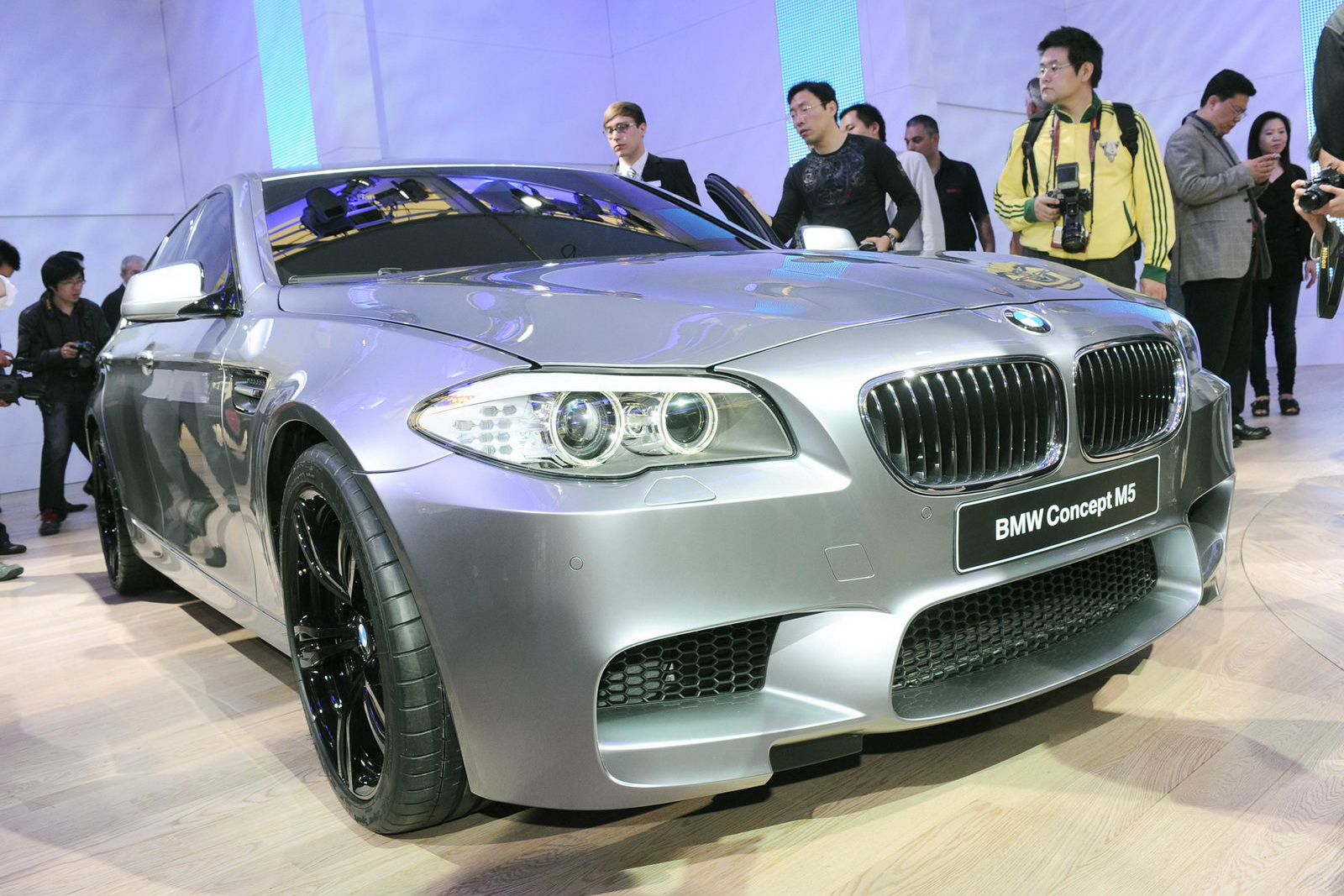
All-new BMW 2012 M5

Revealed in concept car guise at the recent Shanghai auto show, the new BMW M5 will not only be the first turbocharged M5 to hit the streets, but also the first one with an optional all-wheel drive system, or at least that’s what an unnamed company insider told British car magazine, Autocar. The company official said the all-wheel drive model will be built around the upcoming V8-powered M5 sedan, but didn’t go into any further details on the technical specs.
The BMW insider also addressed rumors about BMW working on a long-wheelbase M5 aimed at the Chinese market. "The long-wheelbase platform is reserved for standard versions of the 5-series sold in the Chinese market. There are no existing plans for an M5 on this structure," the source said.
The new BMW M5 will use a modified version of the 4.4-liter V8 twin turbocharged engine from the X5 M and X6 M, albeit in a more powerful state of tune than the 555 horsepower it develops on the two performance SUVs. BMW did not offer details on the engine output of the M5, as the company doesn't want to ruin the surprise ahead of the production car's reveal at the Frankfurt auto show later this year.
However, the carmaker said the new M5 will have significantly more power than its predecessor while also being at least 25 percent more fuel-efficient. The reduction in fuel consumption will be due to fuel-saving measures implemented by BMW's Efficient Dynamics department such as an automatic stop-start system, brake energy regeneration system and on-demand auxiliary functions for the water pump. Fuel economy will also benefit from a new seven-speed dual-clutch automatic transmission.


GALLERY


Read more In Cars